
Discover How Bone Marrow Donor Matching Process Works
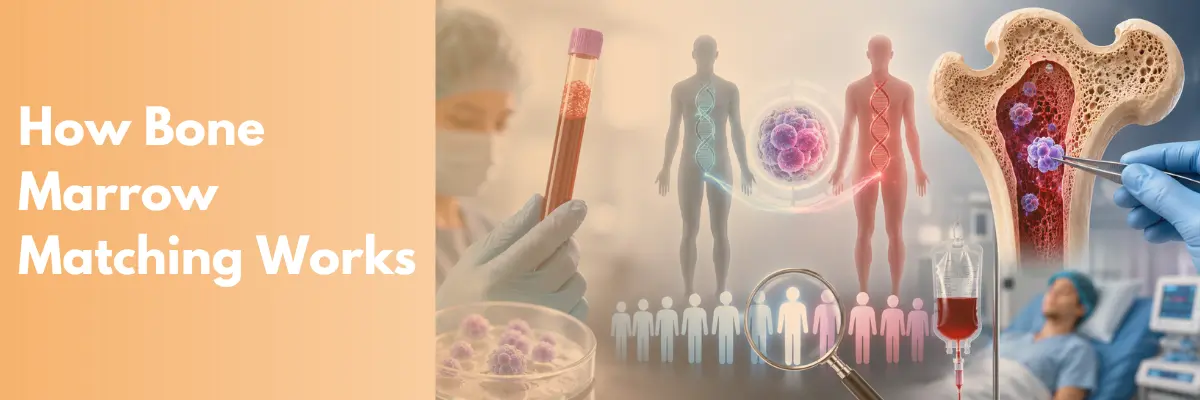
Bone marrow donor matching is a critical step in ensuring the success of stem cell transplantation for patients with blood cancers and genetic disorders. The process primarily depends on Human Leukocyte Antigen (HLA) compatibility, which helps reduce complications such as graft rejection and graft-versus-host disease (GVHD). Different transplant options, including allogeneic, autologous, haploidentical, and cord blood transplants, are selected based on donor availability and patient needs. Comprehensive tests such as HLA typing, blood grouping, and infection screening are essential before transplantation. With advances in donor matching, conditioning therapy, and post-transplant care, bone marrow transplants have become a highly effective treatment option.
Comprehending the bone marrow donor matching process, from screening to surgical isolation, is crucial for directing life-saving allogeneic therapies. A bone marrow transplant, also called a stem cell transplant, is a surgical procedure to replace infected, jeopardised bone marrow with new stem cells capable of forming fresh blood cells in the body. Such treatment is opted for by patients dealing with lethal blood disorders such as multiple myeloma, leukaemia, acute aplastic anaemia, lymphoma, and genetic blood conditions.
To execute a successful bone marrow transplant, doctors are required to briefly assess Human Leukocyte Antigens. The HLAs are the proteins found on most cells' surfaces that help the immune system to differentiate between “foreign” which are non-identifiable pathogens or transplanted organs and “self”, meaning the body’s own tissue and material residing in the body.
Role of HLA for Bone Marrow Transplant Blood Type Matching?
The human leukocyte antigens are generally inherited from both parents, which marks the dictation upon tissue’s compatibility. Matching both parents closely can assist in reducing risks of dealing with difficulties like graft-versus-host-disease or graft rejection.
Graft rejection implies the recipient’s system is recognizing the donor’s stem cells as “foreign” and wiping them out before getting established. Whereas, under graft-versus-host disease, new cells attack the recipient's body tissues like the liver, skin, and GI tract.
In order to ascertain compatibility, doctors, clinicians, or scientists typically analyze HLA typing for bone marrow transplants, such as HLA-A, HLA-B, and HLA-C, belonging to Class I loci on nucleated cells. Whereas HLA-DRB1, HLA-DPB1, and HLA-DQB1 belong to Class II Loci, which are expressed on specific immune cells. The matches are interpreted as a numeric fraction that is based on the number of loci evaluated, as mentioned below:
|
HLA Label |
Loci (Location) |
Meaning |
|
10/10 Match |
HLA-A, B, C, DQB1, DRB1 |
Low risk of GVHD |
|
8/8 Match |
HLA-A, B, C, DRB1 |
Highly suitable for unrelated donors |
|
9/10 or 7/8 Match |
Single Locus Mismatch |
Used as a backup when no full match is found |
|
5/10 Match |
Family’s half-matched Donor |
Readily available from family members |
Learn About the Types of Bone Marrow
Yellow Bone Marrow: Found in a hollowed center of long bones containing fat cells, also called adipose tissue. Its role is to reserve energy and transform into red bone marrow during critical blood loss.
Red Bone Marrow: This bone marrow is situated in flat bones such as the skull, pelvis, and ribs, and is formed with the help of hematopoietic tissue, which generates red blood cells, platelets, along with white blood cells.
For transplantation purposes, only blood stem cells or red bone marrow are targeted to be introduced into the bloodstream, as they consist of hematopoietic cells which reconstruct the blood system entirely.
Transplant Options for Bone Marrow Donor Matching Process
Explore numerical variations of bone marrow transplants, curated for the patient’s specific health conditions along with donor availability:
|
Type |
Source |
What it Does |
|
Patient’s native stem cells |
Reintroduces harvested stem cells after a high dose of chemotherapy. |
|
|
Allogeneic Transplant |
A compatible related or unrelated donor |
Provides graft-versus-leukemia effect where donor’s cells remove cancer cells. Need detailed analysis of the bone marrow donor matching process |
|
Syngeneic Transplant |
Identical Twin Donor |
Consists of no risk of rejection or GVHD but deficient of graft-versus-leukemia against cancer cells |
|
Umbilical Cord Blood Transplant |
Stem cells from umbilical cord blood |
Tolerates HLA mismatching due to high quantity of immature cells. |
|
Haploidentical Transplant |
Half-matched donor, family member preferred |
A 50% match with 95%+ success due to finding a bone marrow donor in the family |
To be noted that among family donors, the sibling bone marrow match probability has proven to be higher compared to other members, as they share a great deal of similarities in inheriting matching HLA, resulting in haploidentical transplant success.
Crucial Tests To Take Before Finding a Bone Marrow Donor
Before moving ahead with the transplant process, the recipient is required to undergo a series of tests to match stem cell donor compatibility:
-
HLA Typing Test: Next Generation Sequencing (NGS) or Polymerase Chain Reaction (PCR) to identify the DNA sequence of HLA alleles.
-
ABO and Rh blood grouping for bone marrow transplant blood type matching.
-
Complete Blood Count or CBS to study both hosts' and recipients' overall blood health.
-
Panel reactive Antibody (PRA) or donor lymphotoxic crossmatch to prevent serious rejection
-
Screenings like HIV, Hepatitis B/C, Epstein-Barr virus (EBV), and Toxoplasmosis to rule out infectious diseases through any possible transmissible infections.
-
Organ tests for proper function of body organs like the liver, kidney, and heart to ensure the patient’s toleration.
The Execution of Bone Marrow Donor Matching Process
After the surgery process is done. The treatment is then followed by conditioning therapy, as the patient’s bone marrow and immune system are in a vulnerable state, with almost no white blood cells. Due to this, patients need to reside in isolation, inhaling High efficiency Particulate Air (HEPA) to wipe out airborne pathogens for several weeks post infusion until fresh stem cells are formed and start producing immune cells.
For better recovery visitor access, strict hygiene regime, controlled hospital environment prioritized while the patient’s immune begins to establish itself. Additionally, the medical teams periodically keep track of the patient’s absolute neutrophil counts (ANC) on a daily basis in order to keep an eye on graft-versus-host disease.
Also Read: How to Choose the Best BMT Hospital in India: A Checklist
Conclusion
Dealing with the bone marrow donor matching process demands an understanding of how the genetic markers dictate a successful transplant. An HLA of 8/8 or 10/10 persists as the main target for long-term results. Modern conditioning and rigorous post-transplant care regimens have proven 5/10 haploidentical transplant as a viable option with a high success rate as well. By strictly evaluating HLA suitability, verifying donor sources, and handling post-transplant isolation conditioning. Medical teams can now safely deliver a restorative stem cell therapy to patients with critical conditions.
Frequently Asked Questions
1What is meant by sibling bone marrow match probability for a patient?
The probability states that siblings sharing the same parents have a 25% success rate for a complete HLA match. Moreover, such combinations consist of a 50% haploidentical transplant success rate, with the remaining 25% being completely unmatched.
2How long does it take to find a match from an unrelated registry?
Finding an unrelated match through both national and international registries takes an average time between 4 - 12 weeks, as it requires attending plenty of sessions, proper clearance of the donor’s health, and high-quality HLA testing.
3What is the process of verifying the donor’s stem cell compatibility before the surgery?
It is confirmed via high-resolution DNA sequencing to assess the main HLA loci, which are HLA-A, B, C, DQB1, and DRB1. In addition to sequencing, several blood tests are done to cross-check whether the patient possesses any antibodies against the host’s tissue.
4Why is it necessary to put the patient in an isolated facility?
It is a mandatory step to safeguard the patient from both known and unknown infections due to a weak immune system, which slowly copes while residing in the facility.